


Mojo has speed. Now it has an enterprise toolkit.
When Modular launched Mojo, they solved a fundamental problem: Python's beloved syntax trapped behind interpreter overhead. Mojo delivers Python's ergonomics with systems-language performance. On key benchmarks, optimized Mojo code matches or exceeds C and Rust—placing it among the most efficient languages available.
But raw speed isn't enough for production systems.
Enterprise applications need authentication, observability, resilience patterns, and data persistence. They need standards compliance for interoperability. They need battle-tested patterns that prevent 3 AM incidents.
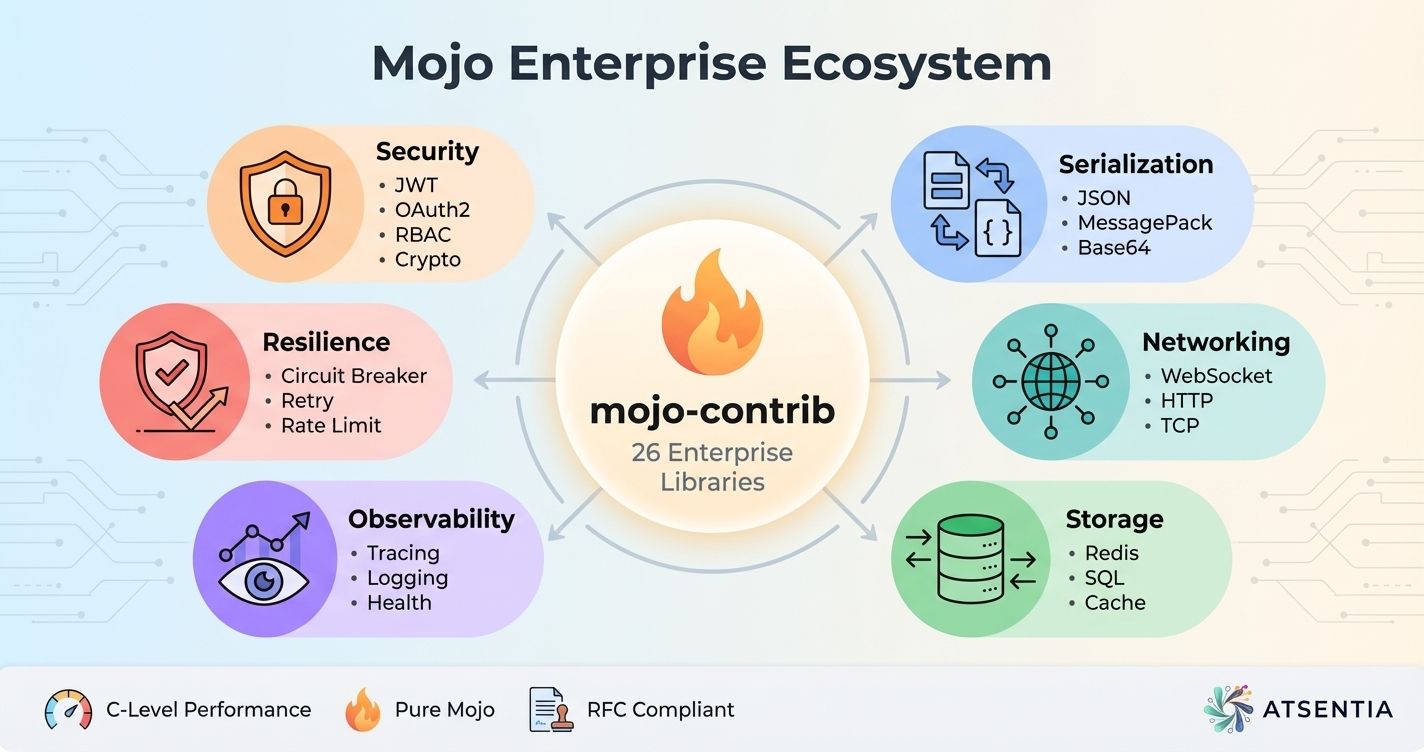
That's why we built mojo-contrib: 26 pure Mojo libraries covering the full enterprise stack.
The Performance-to-Sustainability Pipeline
Every CPU cycle saved is energy not consumed. In an era where AI workloads strain power grids and cloud budgets alike, choosing an efficient language matters.
Mojo sits at the top of the performance spectrum—competing with C and Rust in benchmarks while offering Python's readability. This isn't just about being "faster than Python." It's about being among the most resource-efficient options available for any workload.
The sustainability case writes itself: efficient code means less compute for the same work. Less compute means lower cloud bills, reduced energy consumption, and smaller carbon footprint. You extract maximum value from existing hardware instead of provisioning new servers.
Pure Mojo libraries amplify this advantage. No Python interpreter overhead. No cross-language marshaling costs. Just efficient, compiled code running at hardware speed.
What Enterprise Systems Actually Need
Identity & Security
Production APIs don't ship without authentication. Our JWT implementation follows RFC 7519 with constant-time comparison to prevent timing attacks. OAuth 2.0 support includes PKCE for mobile apps and pre-configured providers (Google, GitHub, Microsoft, Okta). Role-based access control layers on top.
Resilience Patterns
Distributed systems fail. Circuit breakers prevent cascade failures. Retry logic with exponential backoff and jitter prevents thundering herds. Rate limiting protects against abuse. Bulkhead isolation contains blast radius. These aren't nice-to-haves—they're requirements for systems that stay up.
Observability
You can't fix what you can't see. Our distributed tracing implementation speaks OpenTelemetry (OTLP), integrating with Jaeger, Tempo, and other industry backends. W3C Trace Context headers correlate requests across service boundaries. Structured logging and health probes complete the picture.
Data Layer
Redis client for caching and pub/sub. Type-safe SQL query builder with connection pooling. JSON and MessagePack serialization. Session management. The unglamorous infrastructure that every production system depends on.
Why Pure Mojo Matters
We deliberately minimized external dependencies. Most libraries are 100% Mojo with zero Python interop.
This matters because:
- Performance: No interpreter overhead, no marshaling costs
- Security: Smaller attack surface, no supply chain from pip
- Deployment: Single binary, no virtualenv management
- Reliability: Compile-time type checking catches errors before production
When you do need Python ecosystem access (FastAPI for HTTP, for example), we provide clean bridges. But the core logic stays in Mojo.
Standards as a Feature
Enterprise systems don't exist in isolation. They integrate with identity providers, observability platforms, databases, and external APIs.
Every protocol we implement follows its RFC or W3C specification:
- JWT: RFC 7519
- JSON: RFC 8259
- WebSocket: RFC 6455
- Base64: RFC 4648
- Distributed Tracing: W3C Trace Context
Standards compliance isn't bureaucratic checkbox-ticking. It's insurance that your Mojo services will work with the rest of your infrastructure.
The Ecosystem Gap
Mojo has 175,000+ developers and a $1.6B valuation. The language is ready. But mature ecosystems take time to develop.
Node.js has npm with millions of packages (and all the problems that brings). Go bundles a capable standard library. Python has decades of accumulated tooling.
Mojo needs a middle path: curated, cohesive libraries that work together. Not thousands of abandoned packages. Not a monolithic stdlib that can't evolve. A focused collection covering real enterprise needs.
That's what mojo-contrib provides.
Getting Started
Each library is independently versioned but designed to compose. Use mojo-http with mojo-auth for authenticated APIs. Add mojo-trace for observability. Layer in mojo-resilience for production hardening.
Build fast. Deploy efficiently. Extract maximum value from your compute resources.
Explore mojo-contrib on GitHub →
Originally posted at atsentia.com blog