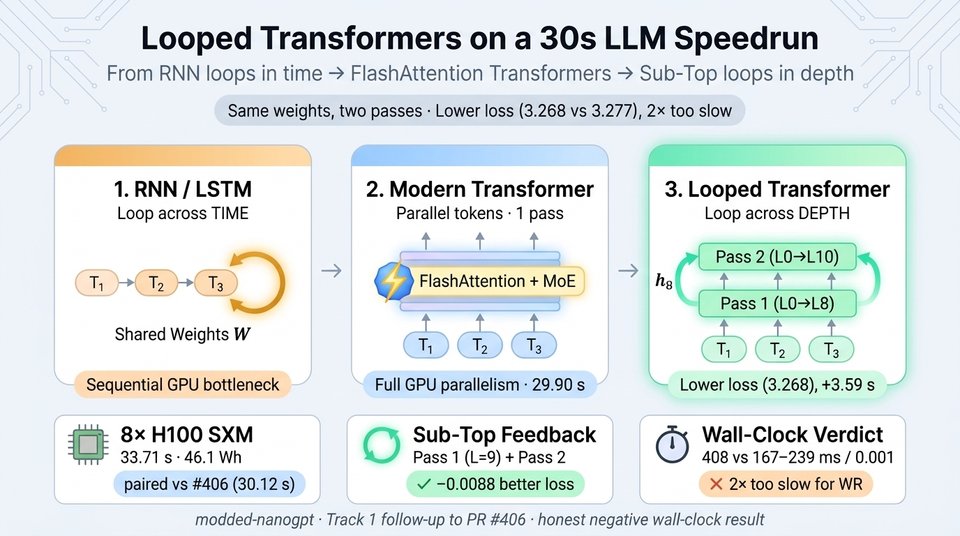
⚠️ Honest negative wall-clock result — no new record today. Yesterday's PR #406 / #407 hit 29.90 s on 8×H100 using purely exact GPU systems fixes. Today we tested whether Looped-Transformer architecture changes could push further by needing fewer training steps. One idea (Sub-Top Feedback) genuinely improved validation loss by −0.0088 (
3.2679vs3.2767), but still cost roughly 2× too much wall-clock time per unit of loss to beat 29.90 s — so we stopped early and skipped the 12-run certification. Negative results that explain why are worth sharing too.
From RNN loops in time to Transformer loops in depth
Before Transformers took over in 2017, sequence models like RNNs and LSTMs were built around an explicit loop across time. The network reused the exact same weights for token 1, then token 2, then token 3, passing a hidden state forward one step at a time. That gave RNNs great parameter efficiency, but a brutal hardware drawback: token 100 had to wait for tokens 1 through 99, leaving modern GPUs mostly idle.
Transformers broke that sequential bottleneck by removing the time loop and processing all tokens in parallel across a fixed stack of layers (11 layers in modded-nanogpt). Over the past few years, hardware-aware variants — FlashAttention (fusing attention into fast on-chip SRAM tiles), rotary embeddings (RoPE), grouped-query attention, FP8 tensor cores, and sparse Mixture-of-Experts (MoE) — have turned single-pass Transformers into relentless GPU matmul engines. That is how the modded-nanogpt speedrun brought GPT-2-scale pretraining down from 45 minutes to under 30 seconds on 8×H100.
Looped Transformers ask an intriguing question: what if we keep all tokens parallel, but bring the RNN-style loop back in depth? Instead of adding more parameters, the model feeds an intermediate hidden state back into the stack and reuses the same weights for a second (or third) pass — letting it "think twice" before predicting the next token.
In code, the core idea is remarkably tiny. Here is the entire diff to turn Jay Mody's famous 40-line NumPy GPT-2 (picoGPT) into a Looped Transformer:
-def gpt2(inputs, wte, wpe, blocks, ln_f, n_head):
+def gpt2_looped(inputs, wte, wpe, blocks, ln_f, n_head, n_loops=2):
     x = wte[inputs] + wpe[range(len(inputs))]
-    for block in blocks:
-        x = transformer_block(x, **block, n_head=n_head)
+    for _ in range(n_loops):                     # loop in depth (reuse same weights)
+        for block in blocks:
+            x = transformer_block(x, **block, n_head=n_head)
     x = layer_norm(x, **ln_f)
     return x @ wte.T
(See the Appendix at the bottom for the NumPy middle-block loop and Sub-Top Feedback variants.)
The idea has a rich lineage — and suddenly moved from theory into headline models in November 2026:
- The origins (2018–2023): Universal Transformers (Google Brain / DeepMind, 2018) first looped a shared Transformer block with adaptive halting; Facebook AI Research's Feedback Transformer (Fan et al., 2020–2021) bridged RNNs and Transformers by feeding deeper layer abstractions back to lower layers; and Giannou et al. (ICML 2023, Looped Transformers as Programmable Computers) formalized the modern "Looped Transformer" name.
- Open-weights & recent releases (2025–Nov 2026): ByteDance's Ouro (2025) scaled looped pretraining to practical open models. In just the last few weeks of November 2026, Thinking Machines Lab released Inkling 2 Mini (an Apache-2.0 MoE looping its middle 12 layers three times, plus a variable-loop 1–5 pass research release), and Z.ai / Zhipu launched GLM-5.4 (running a 28-layer block twice per token on a ~750B base model). On the research side, new variants like the Loopback Transformer (Nov 2026, decoupling geometric residual decay from cross-layer attention) and Sub-Top Feedback (Xiong et al.) cleaned up how looped passes mix history.
- Frontier-lab rumors: Unconfirmed industry reporting (including The Information and recent safety-monitorability discussions) has also pointed to looped / recurrent-depth architectures being explored inside next-generation frontier models at labs like OpenAI, Google DeepMind, and Anthropic — trading parameter bloat for internal latent reasoning passes (while raising new questions about how to monitor thoughts that happen inside loops rather than in visible text).
In yesterday's post, we reached 29.90 s on 8×H100 without changing a single bit of math. With looped Transformers suddenly everywhere, today we asked the opposite question: if a looped Transformer learns more per step, can it cut enough training steps to beat 29.90 s on wall-clock time?
Four looped ideas screened on 1×H100 (and why three died fast)
Before renting an expensive 8×H100 node, we implemented four distinct looped-transformer ideas behind clean toggles on top of #406 and screened them cheaply on a single H100 (total single-GPU screening cost: ~$9):
(Quick unit note: speedrunners often measure tiny validation-loss changes in millinats (mnats), where 1 mnat = 0.001 of cross-entropy validation loss. Lower is better, and Track 1 requires finishing at or below 3.2800.)
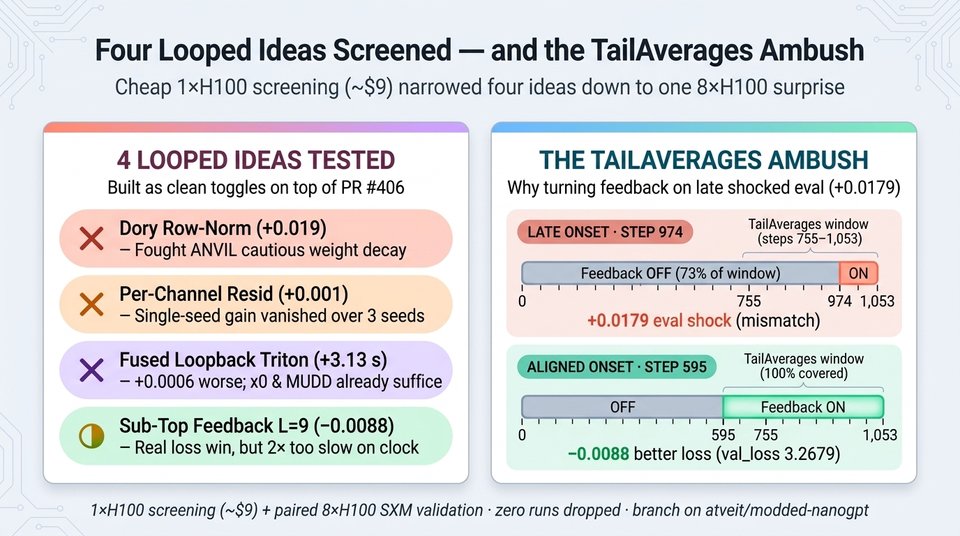
- Dory Row-Norm (
+0.0192worse on 1×H100 — killed in Round 1). Looped models often stabilize repeated passes by clamping weight row norms back to their initial scale. In#406, the ANVIL optimizer already normalizes update row energy and shapes weight norms smoothly with cautious weight decay (wd = 2.25). Hard-clamping weights to step-0 random norms actively fought the optimizer. - Per-Channel Residual Gates (
+0.0010to+0.0014worse across 3 seeds — killed in Round 3). Expanding#406's scalar residual mixing weights into 768 per-channel gates looked promising on a single 600-step seed (−0.0013), after we fixed abfloat16backward reductionNaNwith an explicitfp32column sum. Over three paired 1,500-step seeds, the gain completely vanished. - Sparse Loopback Attention (
+0.0006worse and+3.13 sslower on 8×H100 — killed). Allowing later layers to attend back to earlier layer activations sounded like a natural lightweight loop, so we even wrote a custom 1-pass fused Triton forward+backward kernel to eliminate extra memory traffic. Even fully fused on 8×H100, it added +3.13 seconds and slightly hurt loss (3.2773vs3.2767). Why?#406already hasx0residual gates, value skips, and dense cross-layer mixing (MUDD), leaving almost no untapped cross-layer signal. - Sub-Top Feedback (
−0.0034better across 3/3 seeds on 1×H100 — promoted to 8×H100!). Inspired by Xiong et al.'s Don't feed back the last block (Nov 2026), we run a fast, no-gradient Pass 1 through layers0..8, take the sub-top representationh₈(one layer below the output head), pass it through a zero-initialized linear projection, and inject it into Pass 2 right after the initialx0skip anchor:
# Conceptual Sub-Top Feedback (L=9): Pass 1 refines Pass 2 using the same weights
if step >= subtop_start_step:
    with torch.no_grad():
        h_subtop = run_layers_0_to_8(x_in)           # Pass 1 (no grad, 9 layers)
    x_pass2 = x_pass2 + scale * fb_proj(h_subtop)    # Inject post-x0, keep x0 pure
out = run_layers_0_to_10(x_pass2)                    # Pass 2 (full 11 layers + grad)
Two early 1×H100 lessons made this work: injecting before the x0 skip corrupted the shared embedding space (+0.098 blowup!), and stopping Pass 1 earlier at layer 6 or 7 completely destroyed the gain (+0.0021 / +0.0025). Only the true sub-top layer (L=9) delivered a clean 3/3-seed win (−0.00339 ± 0.00116, paired t = −5.06).
Plot twist #1 on 8×H100: the TailAverages ambush
Confident from the 3-seed 1×H100 result, we snagged an 8×H100 SXM5 node (NV18 NVSwitch) on RunPod and ran Sub-Top Feedback turning on during the final taper stage (step 974 of 1,053) — expecting a surgical loss drop with only +0.49 s of extra compute.
Instead, validation loss exploded by +0.0179 (3.2946 vs 3.2767), and repeated at +0.0069 on a second seed.
What happened? On 1×H100 we evaluated the final model weights directly. On 8×H100, #406 evaluates TailAverages — a running average of the final 298 steps (755..1053). By turning Sub-Top Feedback on at step 974, 73% of the averaged backbone weights had trained with zero feedback, while the new feedback projection itself wasn't averaged at all. Evaluation was feeding a live feedback signal into a mostly unlooped averaged model!
To prove the diagnosis, we swept the onset step earlier so Sub-Top Feedback would cover more of — and then 100% of — the 298-step TailAverages window:
START = 974(79 active steps, hot):3.2946(+0.0179, severe eval shock)START = 974(79 active steps, mid):3.2763(−0.0004, barely moving)START = 848(205 active steps):3.2732(−0.0035)START = 595(458 active steps — 100% ofTailAverages):3.2679(−0.0088better than#406— and reproduced on our profiler run at3.2686!)
That is a massive, reproducible sample-efficiency improvement right at the 3.28 frontier — with zero extra backbone parameters.
Plot twist #2: better loss, 2× too slow on the stopwatch
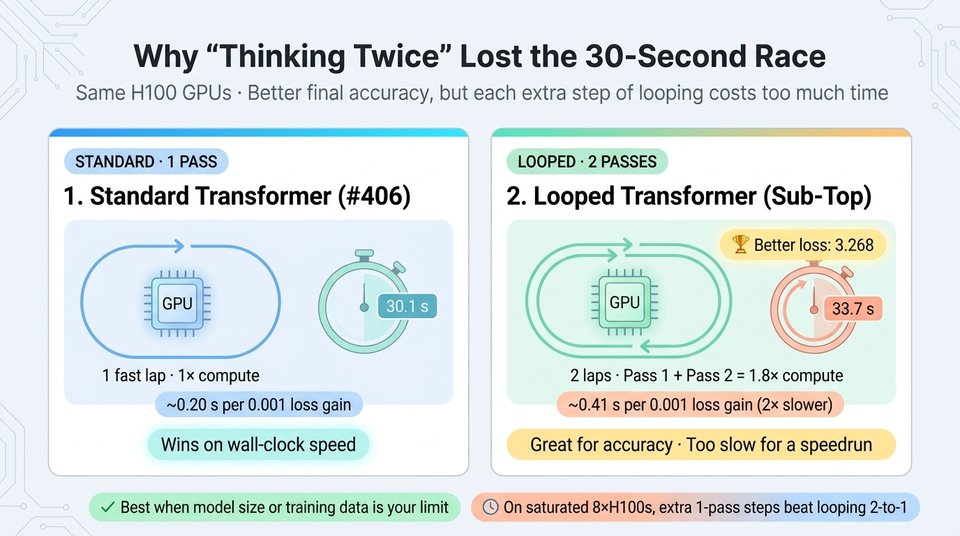
Here is the catch that killed the world-record bid. Look at the full paired 8×H100 scoreboard (every run 1,053 steps on the exact same node):
| Run | Config | Wall Time | Validation Loss | Δ Loss vs #406 |
Extra Time / 0.001 Loss |
GPU Energy (NVML) |
|---|---|---|---|---|---|---|
#406 baseline (cold, s42) |
1-pass standard | 30.35 s |
3.2767 |
baseline | 167–239 ms (ref) |
39.9 Wh |
#406 baseline (warm, s43) |
1-pass standard | 30.12 s |
3.2796 |
— | 167–239 ms (ref) |
43.2 Wh |
Sub-Top START=974 (hot) |
L=9, late onset |
31.54 s |
3.2946 |
+0.0179 |
shock | 44.6 Wh |
Sub-Top START=974 (mid) |
L=9, late onset |
31.02 s |
3.2763 |
−0.0004 |
1,225 ms |
44.5 Wh |
Sub-Top START=848 |
L=9, 205 active st |
31.75 s |
3.2732 |
−0.0035 |
466 ms |
46.0 Wh |
Sub-Top START=595 |
L=9, 458 active st |
33.71 s |
3.2679 |
−0.0088 |
408 ms |
46.1 Wh |
Sub-Top START=595 (repro) |
Same + CUPTI trace | 33.95 s |
3.2686 |
−0.0081 |
repro | — |
| Fused Loopback Attn | Custom Triton kernel | 33.25 s |
3.2773 |
+0.0006 |
regressed | 44.7 Wh |
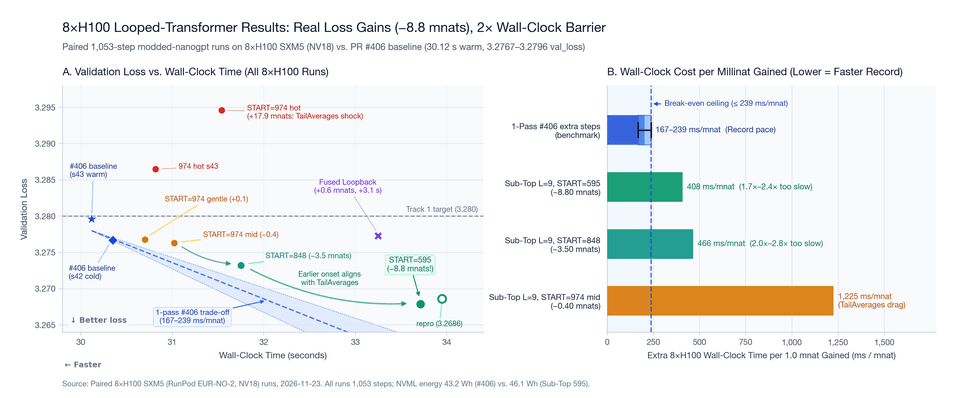
On this 8×H100 setup, simply running extra 1-pass #406 steps near 3.28 buys 0.001 of validation loss for roughly 167–239 ms. Even at its strongest operating point (START=595, −0.0088 loss), Sub-Top Feedback's 9-layer Pass 1 added +3.59 s — costing 408 ms per 0.001 of loss, or 1.7×–2.4× slower than standard 1-pass training (and burning 46.1 Wh vs 43.2 Wh).
Why? Because #406 is already compute-saturated on H100s. When every GPU core is already busy, doing an extra 9-layer Pass 1 (~+7.8 ms/step) has to deliver nearly twice the learning per FLOP to pay for itself in wall-clock time. Sub-Top Feedback is a genuine win if you are parameter-constrained or data-constrained — just not if you are racing a 30-second stopwatch on 8×H100.
Once that ratio was crystal clear across three onset points (1,225 → 466 → 408 ms), we stopped and skipped the ~$20 12-run certification run.
Where this sits relative to previous record attempts (estimated)
We did not re-run earlier PRs on today's EUR-NO-2 node, so this is a cross-node estimate anchored by our paired #406 runs (29.90 s on yesterday's certification node vs 30.12 s warm on today's node — a +0.74% node-speed offset):
| Attempt / Variant | Normalized to 29.90 s node |
Validation Loss | vs #406 (29.90 s) |
Basis |
|---|---|---|---|---|
#407 / #406 (Attempt #3, Nov 22) |
29.90 s |
3.2778 |
baseline | measured (12 runs) |
#404 (@caraxesml, Nov 19) |
30.05 s (30.25 s GKE) |
3.2795 |
+0.15 s |
measured (interleaved) |
#397 / #396 (Attempt #2, Oct 31) |
30.58 s (30.67 s PR) |
3.2786 |
+0.68 s |
measured (same node) |
#393 (@francesco-prignano, Oct 25) |
31.29 s |
≤ 3.28 |
+1.39 s |
reported PR time |
Sub-Top START=595 (early-stop est. at 3.278) |
~31.4–32.0 s |
~3.278 (est.) |
+1.5 to +2.1 s |
estimated (giving back −0.0088 @ 167–239 ms/0.001) |
Fused Loopback Attn (1,053 st) |
~33.01 s |
3.2773 |
+3.11 s |
estimated (node-scaled from 33.25 s) |
Sub-Top START=595 (full 1,053 st) |
~33.47 s |
3.2679 |
+3.57 s |
estimated (node-scaled from 33.71 s) |
#391 (Attempt #1, Oct 18) |
34.86 s |
≤ 3.28 |
+4.96 s |
reported PR time |
Even if we cut Sub-Top START=595 short to spend its entire −0.0088 loss surplus and stop right at 3.278, it would still land around ~31.4–32.0 s — faster than my first attempt (#391, 34.86 s), roughly near #393 (31.29 s), and still 0.8–2.1 seconds behind #396, #404, and #406. That shows just how tight the sub-31-second regime has become: a 3-second architectural overhead wipes out a full month of systems gains.
Inside the GPU profiler: what does have room left
Before shutting down the 8×H100 node, we captured full Rank-0 NVIDIA CUPTI traces across all three training stages — including Stage 3 Taper (steps 980..983), where the model switches to full 50,304-token softmax. Rendering that exact .json.gz trace locally on macOS shows both why Pass 1 was too expensive and where the real remaining wall-clock savings live:
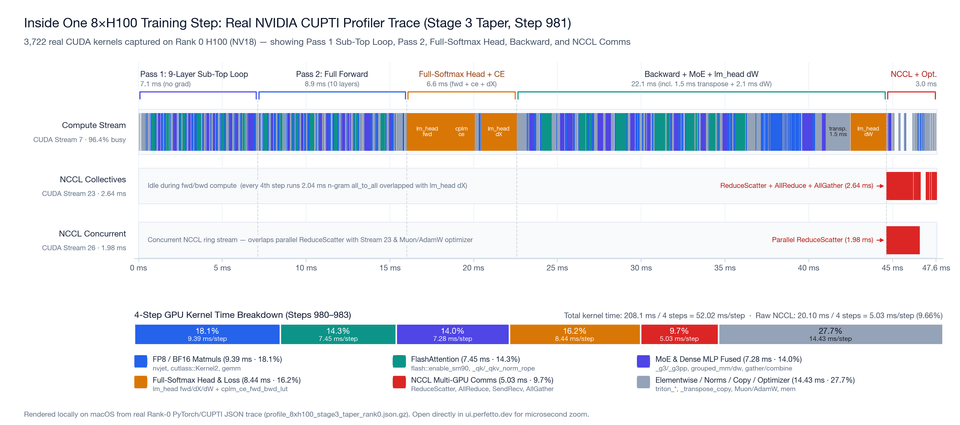
Two clear systems targets — plus visual proof of why looping couldn't hide — jump straight off the Stage 3 trace for a future sub-29.5 s attempt:
- Compute Stream 7 is
96.4%busy, with Pass 1's 9-layer loop eating a solid7.1 msblock right before Pass 2 (8.9 ms). There is essentially zero idle gap for a second pass to hide behind. - Stage 3 full-softmax head + loss (
lm_headfwd/dX/dW +cplm_ce) takes8.44 ms/step(16.2%of all Stage 3 kernel time):6.6 msfor forward + cross-entropy + input gradient (dX), plus2.1 msforlm_headweight gradient (dW) and1.5 msof transpose copies right before it. - Multi-GPU communication is
9.66%of Stage 3 GPU time (5.03 ms/stepraw NCCL): led by gradientReduceScatter(7.89 ms / 4 steps), every-4th-step n-gram embeddingall_to_all(7.04 ms / 4 steps, pushing step 983 to51.9 msvs47.6 ms), and weightAllGather(4.72 ms / 4 steps).
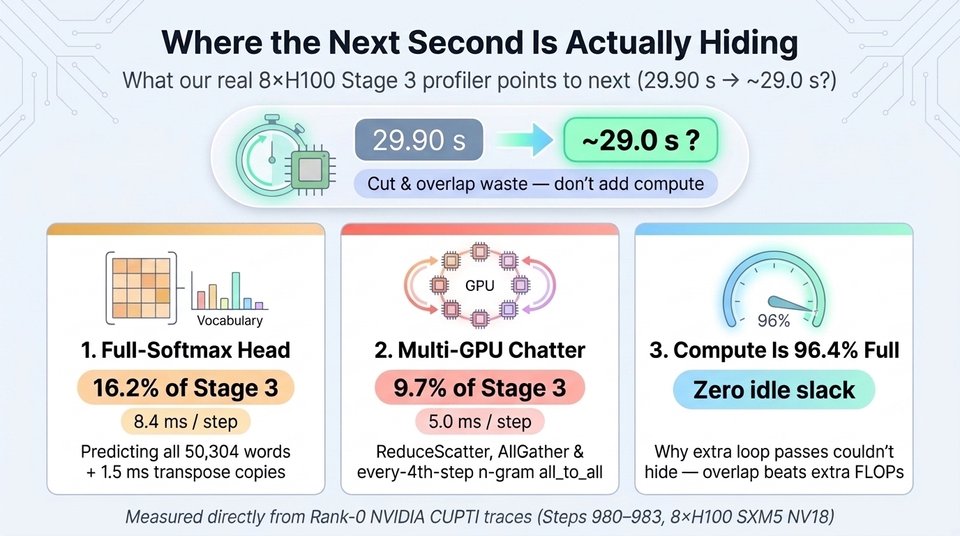
So today didn't break 29.90 s — but we came away with a reproducible −0.0088 looped-transformer finding, a sharp lesson about how TailAverages interacts with late-stage architectural changes, and a microsecond-level Stage 3 profiler map showing where the next real speedups are hiding.
ℹ️ How this experiment was run
Built on top of yesterday's PR #406 (e233546) — full ablation code, Sub-Top Feedback, and fused Triton kernels are available on my public fork branch atveit/modded-nanogpt (attempt/wr4-looped-inspired) (intentionally not opened as an upstream PR since it does not beat 29.90 s). Created with Google Antigravity and parallel Gemini agents for kernel implementation, 1×H100 multi-seed screening (~$9 total on RunPod), 8×H100 SXM5 validation + 10 Hz NVML power telemetry + 3-stage CUPTI profiling, and local macOS trace visualization.
Every run is reported — winners, dead ends, and the TailAverages blowup — and both GPU pods were terminated immediately after capturing the Stage 3 profiler trace.
Key credit & further reading
- Sub-Top Feedback (our most promising result,
−0.0088): Xiong et al. (Nov 16, 2026), Don't feed back the last block — demonstrated that feeding back a sub-top hidden state (h₈) instead of the final layer unlocks substantial validation-loss gains without extra backbone parameters, even when enabled late in training. - Other tested inspirations: Fishman et al. (NVIDIA, Nov 2026), Dory1.0-4B: A Looped Normalized-GPT (Hugging Face); Ouyang et al. (Nov 2026), Loopback Transformer: Towards a Unified View of Residual Looped Transformers.
- Looped Transformer lineage & recent releases: Dehghani et al., Universal Transformers (2018); Fan et al. (Facebook AI Research), Feedback Transformer (2020–2021); Giannou et al., Looped Transformers as Programmable Computers (ICML 2023); ByteDance, Ouro (2025); Thinking Machines Lab, Inkling 2 Mini (Nov 2026); Z.ai / Zhipu, GLM-5.4 (Nov 2026); and Jay Mody's picoGPT.
Appendix: Turning picoGPT into a Looped Transformer
Jay Mody's picoGPT implements a complete GPT-2 forward pass in ~40 lines of pure NumPy (gpt2_pico.py). Starting from the 4-line diff in the intro, here are the two real-world looped variants discussed in this post written in the same minimal NumPy style:
1. Middle-block loop (Inkling 2 Mini / GLM-5.4 style)
Production looped models usually keep a few unique prelude layers at the bottom and coda layers at the top, and loop only the shared middle block n_loops times:
def gpt2_middle_loop(inputs, wte, wpe, prelude, middle, coda, ln_f, n_head, n_loops=3):
    x = wte[inputs] + wpe[range(len(inputs))]

    for block in prelude:                        # 1. entry layers (run once)
        x = transformer_block(x, **block, n_head=n_head)

    for _ in range(n_loops):                     # 2. shared middle stack (looped!)
        for block in middle:
            x = transformer_block(x, **block, n_head=n_head)

    for block in coda:                           # 3. exit layers (run once)
        x = transformer_block(x, **block, n_head=n_head)

    x = layer_norm(x, **ln_f)
    return x @ wte.T
2. Sub-Top Feedback (the −0.0088 variant we tested on 8×H100)
Instead of feeding the raw top layer back into Layer 0, Sub-Top Feedback stops Pass 1 one layer below the top (blocks[:-1]), normalizes and linearly projects that sub-top representation (W_fb, initialized to zero), adds it into the Pass 2 input, and then runs the full stack:
def gpt2_subtop_feedback(inputs, wte, wpe, blocks, ln_f, n_head, W_fb, scale=0.25):
    x0 = wte[inputs] + wpe[range(len(inputs))]

    # Pass 1: run up to the sub-top layer (no gradient during training)
    h = x0
    for block in blocks[:-1]:
        h = transformer_block(h, **block, n_head=n_head)

    # Inject projected sub-top representation into Pass 2 (keeping x0 untouched)
    h_norm = h / (np.sqrt(np.mean(h**2, axis=-1, keepdims=True)) + 1e-6)
    x = x0 + scale * (h_norm @ W_fb)

    # Pass 2: full forward pass reusing the exact same weights
    for block in blocks:
        x = transformer_block(x, **block, n_head=n_head)

    x = layer_norm(x, **ln_f)
    return x @ wte.T
(Note: you cannot simply drop n_loops=2 onto an already-trained standard GPT-2 checkpoint and expect lower loss — the model has to be trained with the loop active so Layer 0 learns what looped activations look like, which is the same distribution mismatch we ran into with TailAverages above.)
Best Regard,
Amund